Forced Labour Trade Bans and Human Rights Due Diligence (HRDD): Why Responsible Contracting Matters
RCP Policy Brief
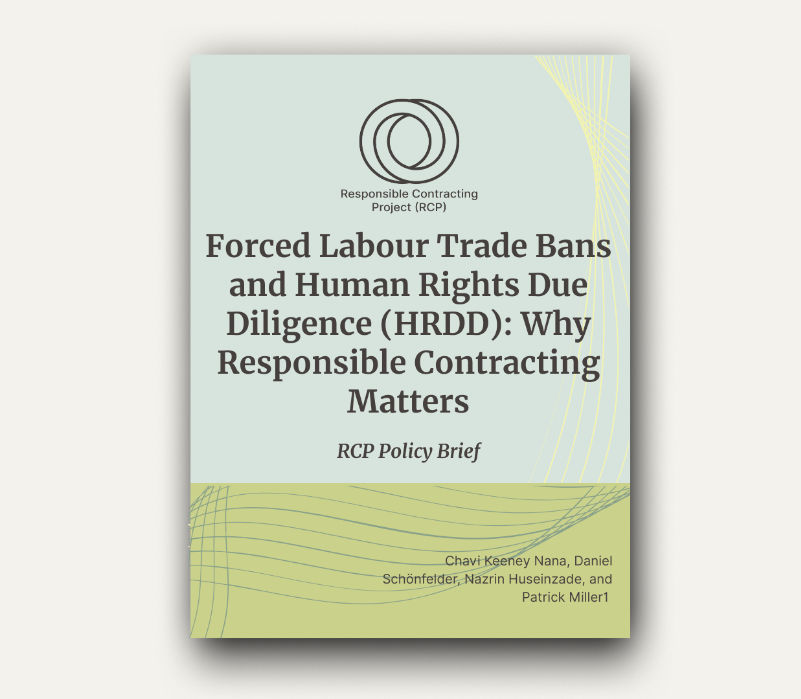
February 2025 – In this Policy Brief, "Forced Labour Trade Bans and Human Rights Due Diligence (HRDD): Why Responsible Contracting Matters," RCP analyzes how international supply contracts can help companies comply with or prevent infractions of forced labor bans in the United States (US) and European Union (EU) markets. Specifically, it reviews Section 307 of the 1930 US Tariff Act, the 2022 Uyghur Forced Labor Prevention Act (UFLPA), and the 2024 EU Forced Labour Regulation (EUFLR).
This Policy Brief makes two central arguments:
-
To avoid violating forced labor bans, companies should carry out effective human rights due diligence (HRDD) to identify, prevent, mitigate, and remediate instances of forced labor in their supply chains.
-
Responsible contracts are critical for effective HRDD and can help ameliorate the risk of forced labor in supply chains. Companies should review their contracts to ensure they are due diligence-aligned. This means moving away from the traditional risk-shifting approach toward a shared-responsibility approach.
Recommendations
The brief recommends that companies wanting to reduce their exposure to trade ban enforcement while increasing the resilience of their supply chain should:
✔ Implement HRDD processes across their operations and supply chains
✔ Familiarize themselves with the core principles of Responsible Contracting and work with legal counsel to integrate the principles into their contracts as part of their HRDD.
✔ Review the table below to understand how responsible contracts enable effective prevention and remediation, which can:
(1) reduce the risk that an investigation would escalate and result in the issuance of a ban (pre-ban) and
(2) expedite resolution after a ban has been issued (post-ban).
Addressing Forced Labor Through HRDD and Responsible Contracts
Human Rights
Due Diligence (HRDD)
Conducting effective remediation to eliminate forced labor indicators and address rights holder
grievances can:
-
Expedite the
modification or lifting of a WRO with respect to future shipments. (Goods that have been sized because they're made with forced labor are never allowed into the US).
Same as above.
Responsible Contracts
Conducting effective remediation to eliminate forced labor indicators and address rights holder
grievances can:
-
Lead to the authorization to resume shipping and importing of goods into the EU.
Conducting effective preventive measures as part of HRDD can:
-
Reduce the occurrence of forced labor, thus reducing the risk of enforcement.
-
Potentially prevent escalation of investigation when forced labor is indicated
-
Allow imports to continue.
Conducting effective
remediation measures as part of HRDD can:
-
Potentially prevent escalation of investigation if forced labor is indicated; and
-
Allow a company to continue to import even if the goods were found to have been made with forced labor.
Pre-Ban: Before an investigation is launched and a ban is issued
Conducting effective preventive measures as part of HRDD can:
-
Reduce the
occurrence of forced labor, thus reducing the risk of enforcement.
Conducting effective
remediation measures as part of HRDD can:
-
Effective remediation will not impact enforcement, as tainted goods cannot enter the US market, regardless of remediation efforts. However, remediation may help to expedite a ban modification as discussed below.
US Tariff Act & Uyghur Forced Labor Prevention Act
Post-Ban: After a ban has been issued
Phase of Action
Pre-Ban: Before an investigation is launched and a ban is issued
Traditional contracts incentivize suppliers to hide problems by making them solely responsible for upholding human rights and environmental (HRE) standards and by
prioritizing traditional remedies, such as order cancellations,
suspension of payments, and termination.
Responsible contracts foster
trust and transparency and enable prevention by:
-
Committing the parties to work together to address forced labor risks as they arise; and
-
Committing the buyer to support the supplier via responsible purchasing practices.
Responsible contracts
support effective remediation by:
-
Setting out a roadmap for remediation; and
-
Placing human rights remediation ahead of traditional contract remedies.

Latest News
-
August 25 — RCP announced a new collaboration with UN Global Compact Network Germany: a three-part webinar series on Responsible Procurement covering "Responsible Procurement and Shared Responsibility" (Oct 22), "Responsible Purchasing Practices" (Nov 11), and "Responsible Contracting" (Dec 2), with RCP Director Sarah Dadush speaking at the December session.
-
August 12 — RCP submitted its response to the European Commission's public consultation on CSDDD implementation guidelines, calling for shared responsibility and human rights and environmental due diligence to be embedded in international supply contracts.
-
July 22 — RCP launched its latest tool, the Responsible Contracts in the Cobalt Industry guidance, developed in collaboration with the Cobalt Institute.
-
May 1 — RCP published a new analysis of the CSDDD and contracting in light of Omnibus I on the Oxford Business Law Blog: Moving Toward Shared Responsibility: How the EU’s CSDDD and Omnibus I Reimagine Contracting for Human Rights and Environmental Due Diligence. Also available as a PDF.
-
April 27 — RCP Director Sarah Dadush and Senior Advisor John Sherman co-authored an essay for Shift's series marking the 15th anniversary of the UN Guiding Principles on Business and Human Rights (UNGPs), titled, From Social Norm to Legal Practice: Fifteen Years of Integrating the UNGPs into Business Law.
Events
-
August 11 — RCP Lead European Legal Advisor Daniel Schönfelder joined "Making Sustainable Contracts Work in Practice," a WorldCC Foundation panel in the APAC Summit's virtual program, alongside Anne Ketola of Tampere University and Ro Coroneos of Praxis ESG, moderated by Gitika Makker of Nexdigm, discussing practical tools for embedding sustainability into contracts, including RCP's toolkit. Watch the recording.
-
June 30 — RCP Director Sarah Dadush joined Observatoire de la Responsabilité Sociétale des Entreprises (ORSE) and PwC Société d'Avocats in Paris for the launch of ORSE's updated ESG regulations guide, discussing the shift from risk-transfer contracting to cooperation-based approaches reflected in the CSDDD.
-
June 2 — RCP Director Sarah Dadush facilitated "Contracting for Sustainability," a workshop at the 2026 Annual Conference on Legal Issues in Social Entrepreneurship and Impact Investing, co-organized by NYU School of Law's Grunin Center and the Impact Investing Legal Working Group, drawing over 40 participants.
-
May 19 — Senior Advisor Ben Rutledge spoke at the Sustainable Vanilla Initiative (SVI) General Assembly in Paris, joining industry members and value chain actors for a session on governance, procurement, and collective action in the vanilla sector.
-
May 14 — Senior Advisor Ben Rutledge presented RCP's Responsible Contracting in Spice Supply Chains Guidance at the Sustainable Spices Initiative (SSI) General Assembly 2026 in Murcia, Spain, attended by nearly 100 delegates from around 50 organizations.
In Collaboration with